The Met Office has issued a yellow warning for rain from 9am to 10pm on Thursday 15 January.
If you see a highways emergency, please call 0345 606 6171.
Find out more about severe weather affecting Suffolk, including how to prepare.
The Met Office has issued a yellow warning for rain from 9am to 10pm on Thursday 15 January.
If you see a highways emergency, please call 0345 606 6171.
Find out more about severe weather affecting Suffolk, including how to prepare.
Learn about on-street charging, Plug-in Suffolk's installation programme and how the project is being funded. To see details about a specific chargepoint, visit Map of Plug in Suffolk chargepoints.

To support the ever-growing shift to electric vehicles (EV), Suffolk County Council is installing 6,000 on-street chargers over the next few years. Around 25% of Suffolk households do not have access to on-street charging, which is one of the biggest barriers to be able to switch to an EV.
Suffolk County Council has received £5.33m from the Department for Transport to support the roll-out of EV chargepoints across the county, to support residents who cannot charge an EV at home (e.g. due to not having a driveway) and provide them with reasonably priced, on-street chargepoints close to where they live. This is through the Local Electric Vehicle Infrastructure (LEVI) Capital Fund. The LEVI funding can ONLY be spent on public chargepoints. It is not possible to spend it on other things.
We have selected and analysed streets where people tend to park overnight and would have difficulty charging an EV at home. Residents were also invited to nominate streets where they would like to see a public chargepoint installed. Alongside this, we have surveyed streets to assess the power supply, any highway constraints, physical space available, pavement width and parking restrictions. A thorough assessment has taken place.
We will not be introducing “electric vehicle only” parking bays for the chargepoints, as we understand electric vehicles are still in the minority and how vital parking spaces can be on a busy street. Bays will be lined to make them clear for users, but there will not be an ‘EV only’ parking restriction. If concerns are raised over this, we can explore the possibility of enforcing designated parking bays at a later date if required. This would be through a Traffic Regulation Order. You can learn more about this process at Traffic Regulation Orders.
The start date for the works for your street will be added to the Plug in Suffolk map as soon as it is known, along with a detailed design drawing. The start date will also be advertised on the street, on an advanced warning notice (just like any roadworks sign). Existing parking arrangements will be unaffected before and after the installation period. However, there may be minor disruption during the installation itself.
From the beginning of the works, to an active chargepoint, should take around 35 days. Within this 35-day period, the period for construction should be about 10 days, and actual digging will take about 2-3 days. The installation of chargepoints will be made as efficiently as possible to minimise disruption to road users and neighbouring houses.
From 2030, the sale of new petrol and diesel vehicles in the UK will no longer be allowed. This law change is known as the Zero Emission Vehicle Mandate or “ZEV Mandate”. To help residents get ready for this, Suffolk County Council, like other Local Authorities, is rolling-out thousands of public EV chargepoints. The chargepoints are intended to support residents who cannot charge at home by providing an easily accessible charging option on the street; lack of charging infrastructure is one of the main reasons people give for not being able to switch to an EV.
We have received £5.33 million in government funding from the Local Electric Vehicle Infrastructure (LEVI) fund. The funding is specific to providing chargepoints and can only be spent on improving the public charging network in Suffolk. It cannot be spent on anything else, such as potholes or bins.
There are already around 1.7 million electric vehicles on UK roads (2.6m including hybrids), a number which continues to increase. We want to make sure nowhere in Suffolk is left behind, and all residents can charge an electric vehicle nearby, conveniently and safely.
Our aim is for all the chargepoints installed at 7kW and above to have a contactless feature, which will enable you to pay for your charge with a bank card, as you do for purchasing items in a shop.
Suffolk County Council was grateful to receive hundreds of suggestions of streets where residents would like on-street electric vehicle chargepoints to be installed. Those suggestions played a key role in helping us to identify areas for installation, and are being investigated for meeting Highways constraints and connection viability.
The majority of locations, however, have been chosen because residents along the street do not have a driveway or a garage and therefore rely on on-street parking. It is these residents who will benefit the most from the project.
The tariffs for local residents will start at 40p per kilowatt hour off-peak and 50p per kilowatt hour peak time. To access this special tariff, residents should register online at the Believ website. Otherwise, the ‘pay-as-you-go’ tariffs will start at 43p per kilowatt hour off-peak and 53p per kilowatt hour peak time. You can pay through contactless, RFID or Apple pay.
Most of our bollard chargepoints will be 22kW. Each socket delivers 11kW when in use at the same time. This means most EVs would need to be plugged in for 5 to 8 hours to fully charge - ideally overnight when the tariffs are lowest.
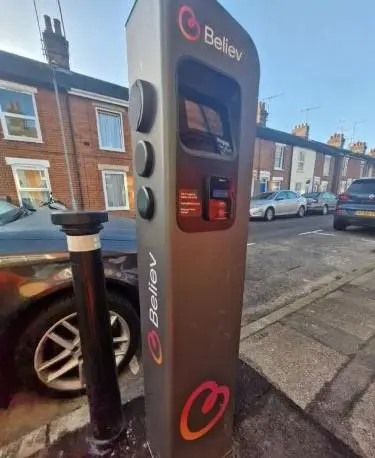
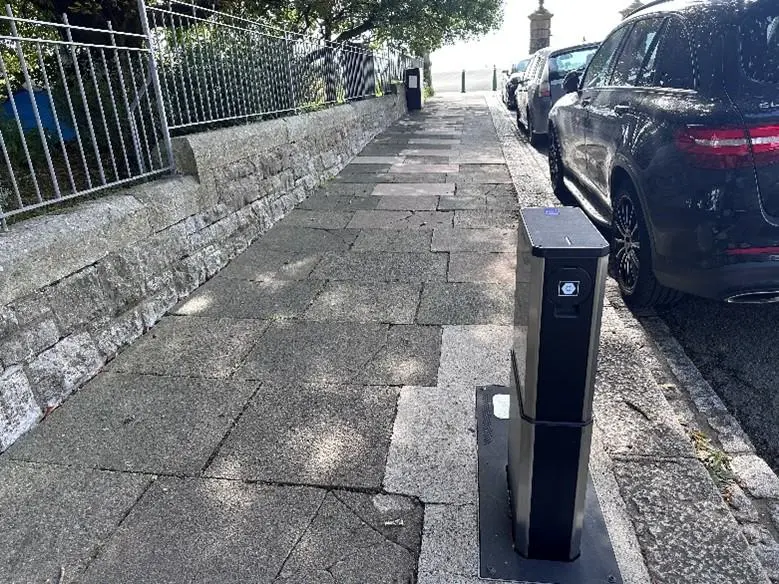
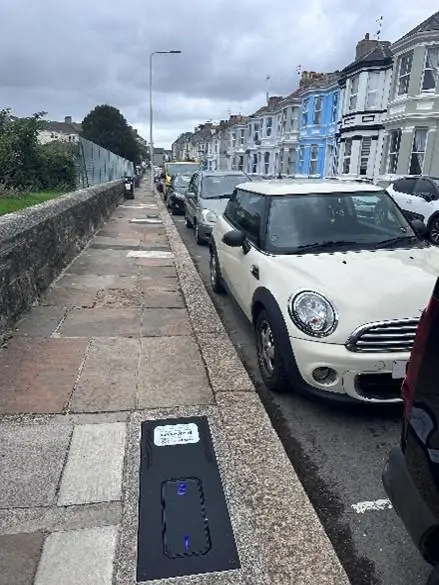
Each freestanding charge point serves two bays, allowing two vehicles to charge at the same time. Currently, on-street chargepoints will be grey, and have dimensions of 312mm (width) x 200mm (depth) x1343mm (height). Chargepoints look like the below picture.